There is a house that I visit in my dreams. I haven’t lived there since I was 12 years old, but it is present and preserved in every dream where I’m “at home.”
The entryway was brick. The sunroom had a cream tile that was cold on my feet even in summer. A small koi pond was at the top of the hill. Among a birch grove beside an apple tree was a treehouse my dad never finished, but where I would go to write in my journal. Years later, even as a homeowner with a daughter of my own, I close my eyes at night and still dream as if we were living in that long-ago house. Every dreamt meal is in that kitchen; every garden stroll in that yard; every front door is that front door.
Naturally, my parents take this as a compliment. From their perspective, the house they raised me in made quite an impression. (Indeed, it was unique and full of passageways that kids adore.) But I’ve long suspected that something else is going on at night – some anxiety of the soul.
During waking hours my daughter inches ever closer to being a toddler. I’ve begun to agonize over the need to choose where her childhood home will be, what it will look like, and the memories it will bear. I can’t predict that she will forever dream of that house in the way I dream of my childhood home, but if she does, where do I want her to visit when she closes her eyes?
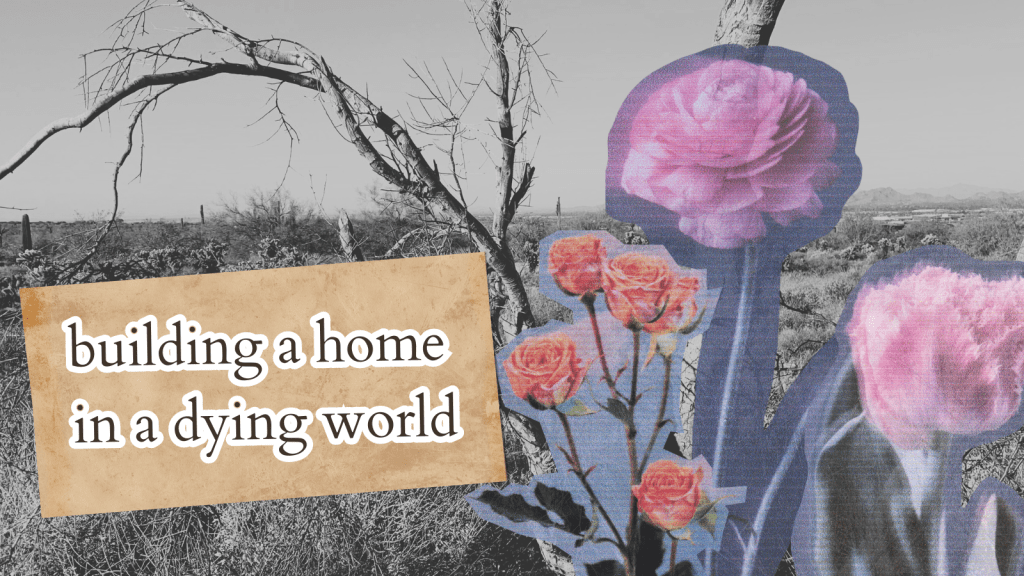
This question is compounded with a greater, existential anxiety: How does one raise a family in a dying world?
Ecology comes from the Greek oikos and logos. Translatable in so many ways, it could be “dwelling” and “law”, or “home” and “nature.” Thomas Moore defines ecology as “the mystery of home” – that is, in essence, the mystery of our soul’s deep and demanding longing for a sense of home. “It’s not uncommon to live in a house that is not a home,” Moore writes. “Just as it’s possible to find some satisfaction of the desire for home in something that isn’t a house. Some people feel very much at home deep in the woods or high on a mountain trail; others feel more home on a busy city street.” (Moore, p. 137) As much as I have loved some of the houses and apartments I’ve lived in, none have had the intimacy and lasting importance as my childhood home had. That longing dulled in the years I was distracted by my career, travel plans, and artistic hobbies, but it has since returned like a thunderous dragon. Now I long for a sense of home not for me but for me and my new daughter.
From where does this longing emerge? Home offers security and identity through belonging to a place, through a sense of spiritual and emotional containment by it. Diasporic peoples know this yearning of home-finding well. Home should be, a we imagine it, the base from which we begin all our quests, our pilgrimages, and our adventures. We are all searching for our shire of hobbits.
Each of us must make an informed bet about where to build a “home” for our children. In the United States, it’s considered safe to bet on suburbia. Others dream of city life and the opportunities it affords. Some may long for a homestead, urban or rural. Some of us stay close to their support networks, others emigrate. In the 21st century, more and more people are considering a new factor: climate change. And dozens of articles are written to satisfy that anxiety. Here’s a sampling:
- Here’s The Best Place To Move If You’re Worried About Climate Change – FiveThirtyEight
- Best Places to Live In a Future Troubled by Climate Change – The Balance
- Where to Live to Avoid Natural Disasters – Business Insider
- Where should you move to save yourself from climate change? – The Guardian
I’ll spare you a read: There is nowhere to go to escape ecological collapse.
I’ve looked at climate preparedness rankings, government commitments, impact maps, articles silly and earnest, and how the most sustainable cities in the world did it. I read all this because I’m looking for a home, and I’d like it to be habitable. But the ability to even consider moving from where I currently live is itself a privilege – a privilege held mostly by citizens of nations responsible for this destruction in the first place.
After all this stress, I argue (like Moore) that the best way forward in the era of ecological collapse is to prioritize homemaking. In the face of a global climate emergency our challenge is less about where to build home but how we will help home emerge in a degraded landscape.
The call to focus on our homes amidst the climate crisis isn’t a rejection of the need to give our attention to the planet and the environment. I am not advocating that we throw our hands in the air and settle in for catastrophe. I’m advocating for Moore’s view: home is all about ecology.
Feeling at home is about how we experience a sense of place and belonging, a sense that is increasingly unattainable on a planet that is increasingly uninhabitable. Moore observes that “excessive attention to our quests instead of our homes may be responsible in part for our neglect of an ecological way of life.” (Moore, p. 138) It’s critical to understand that women are the worst afflicted this neglect because of the resulting depletion in resources. Like women across the world, I am a caregiver, lover, and responsible for the survival of my family. I don’t know the struggles of walking many miles to collect water and firewood, but I do know the struggles of being a breastfeeding breadwinner for my household.
Households rely on women for resource management. This may take the form of household budgeting, meal planning, or ensuring adequate water is fetched or the goats are fed. In Vandana Shiva’s essay “Let Us Survive,” she argues that the justification for ecocide came from the delegitimization and displacement of women’s holistic knowledge of their local ecosystems. “The ecological destruction of nature,” she writes, “goes hand in hand with the intellectual destruction of women’s knowledge and expertise.” (Shiva, p. 69) It’s not new to point out how women’s close relationship with nature has led to women’s exploitation and domination alongside exploitation and domination of the environment. As a mother in a “developed” (over-consuming) economy, to observe the world’s degraded ecosystems that once sustained families is to feel not even a glimpse of the pain women on the frontlines of ecocide experience.
The capitalist patriarchy has abandoned a sense of life’s sacredness for a new worship of development – development that encourages over consumption, exploitation, and the destruction of the natural world. Our planet has a chance at recovery if we shift to degrowth economics and an end to fossil fuels, but this feels like an unlikely utopia. The task of “sustainability” is too large and too overwhelming for the public to swallow or act on. A cause for saving the planet is simply too abstract; people need actionable pathways for stewardship. What better actions, then, but the ones we can take to to act ecologically in our towns, neighborhoods, and homes?
During the Edo period of Japan (1603-1868), farmhouse roofs were typically constructed from thatch. The thatched roof was efficient and strong, but it needed to be replaced every twenty to fifty years. Thatching a single farmhouse roof was a massive undertaking that required the labor of the entire community. Thatch was sourced from a communal thatch reed field which only yielded enough material to thatch one house per year. So, what to do? The community decided in advance which houses would have their roofs replaced and work together, annually, to see each project through. In this way, the entire community had a literal hand in the construction of shelter for their neighbors. “Individuality is not achieved by defending oneself against community,” wrote Moore. “On the contrary, it can only be found in the context of community.” (Moore, p. 139)
The communal lifestyle of the Edo period is not accessible to us now, but we can learn from the principles of ecology. Part of that is respecting resource management, an area that women have traditionally owned in many, many cultures. Otherwise, the task of “creating and conserving life is lost to the ecologically alienated, consumerist elite women of the Third World and the over-consuming West.” (Shiva, p. 71)
Wherever we find ourselves raising our children, the call to restore the ecology of Earth is a call to participate in the ecology of our homes. Individualist survival techniques are not the way – relationship is:
“Soulful education in ecology involves an evocation of home that may start on the surface as responsibility and the pragmatics of living, but must go deeper in order to satisfy the soul. Deeper levels would include an attachment to place, ways of sustaining memory, and stories about places and objects that give them fantasy and therefore a basis for relationship. Relatedness, whether among people, things, or places, requires story and memory which ultimately lead to value and reverence.”
Moore, p. 140
The relatedness Moore describes is not a xenophobic, fevered attachment to one’s home or region. That is not ecology. As Moore argues, that sort of attachment is defensive and soulless. Instead, it’s an understanding that some of the best ways that a place is expressed is through its attachment to history, story, communal activities, and food culture. As people migrate, histories and communal activities will be lost. As agriculture suffers so too will food culture. In the face of loss it is on us to strive to enrich a sense of home in what remains; to enrich the places in which we find ourselves; to build on and with traditions and customs.
How do we build a home for our children in a dying world?
When we define ecology as the mystery of creating and maintaining home, we must then include the creation and maintenance of culture and relationship with one another as part of that sacred project. We haven’t yet identified the childhood home our daughter will grow up in, but wherever the dwelling place is so too will we forge attachments to each other, our community, and the land we inhabit.
References
Moore, Thomas. “Ecology: Sacred Homemaking” in The Soul of Nature. Plume, 1996. Print.
Shiva, Vandana. “Let Us Survive” in Women Healing Earth. Orbis Books. 1996. Print.
 BreeFabig.me
Leave a comment