I first began exploring how digital objects are created, managed, and curated about five years ago. The interest came from a desire to craft thoughtful photo essays and footage of my travels in Nepal and Japan. I wanted a kind of theory-driven creative practice – as a digital native, I didn’t want to just “take photos.” I wanted to make meaning.
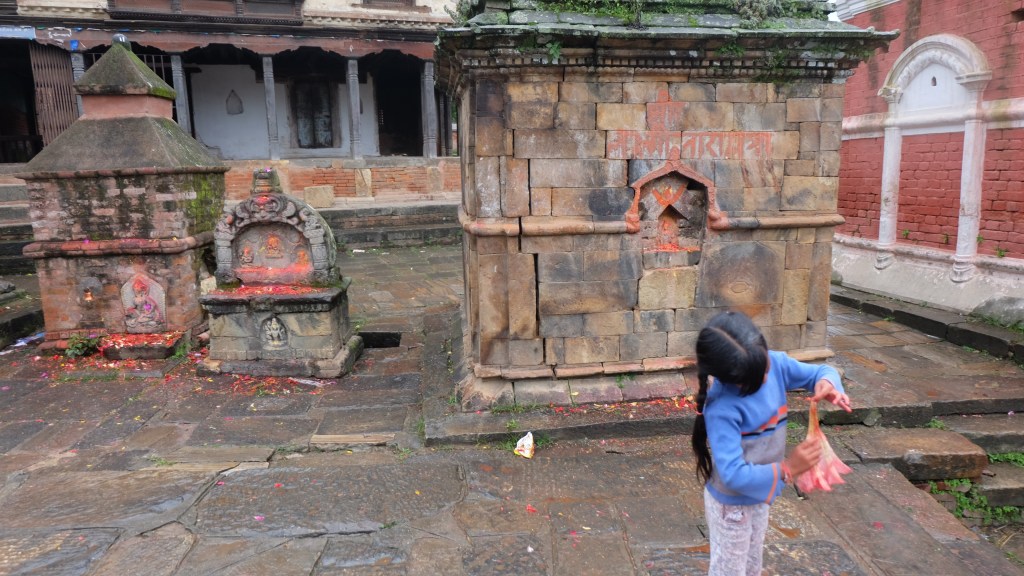
There was something fundamentally different between documentary photography and an Instagram post. I began asking myself how I could communicate what I was learning and experiencing. This led to a series mediocre photos in villages near Bhaktapur that didn’t quite communicate the attempt at photographic fieldwork and storytelling I wanted. (Oh, the courageousness of being 23.) I never shared them anywhere beyond, ironically, Instagram.





In the years since, I’ve started to fully appreciate the entanglement of “reality,” digital space, and materiality through my hobbies and through my career. As part of my job, I help craft and recraft a video through editing, trimming, tagging, writing metadata and presenting that video in many varying, but specific, forms and contexts. In simple terms, it – the video – changes for different audiences and use cases. The 90 minute documentary we receive from a production studio is not the same .mp4 file and metadata that we pass on through an API to any given customer.
I felt those changes were necessary in order for end users to perceive and experience a certain value from the content. I wanted them to take something specific away through consuming a specific version of a video, so it’s recrafted to suit a shared goal. In other words, we are designing for a digital materiality.
Digital materiality deals with digital artifacts as they are interacted with, not in their physical state as matter or energy. Digital objects become, emerge, and reconfigure as and how they are engaged with. Compare this to traditional material things like gold or wheat which are valued at their scarcity and demand. Digital media have a value that cannot be determined in any traditional fashion (though NFTs certainly take inspiration from ideas of value used for physically crafted objects).
In the early days of social media, my parents would warn me that anything I posted online would be there forever. In some respects, that was (and is) true; but what I post online today certainly won’t be valuable forever.
Part of the valuation of digital image, text, object, and video is, as Albers describes, experiential. Consider the disappearing nature of Instagram story posts or the content locked behind a Patreon subscription. We see the notification of a temporary image or video and we have an urge to experience it before it is gone – even if the image is of the ubiquitous foodstagram genre, or a sunset from a familiar neighborhood street. We pay real, material money for access to immaterial digital things. Sometimes we become a Patreon subscriber for entertainment, a parasocial relationship to a content creator, or to learn a skill taught in the locked content.
While a museum houses original works that were crafted by skilled hands, a developed photograph of the object or artwork is on its own a new creative interpretation. Often, those photographed representations of museum-housed objects end up on marketing pamphlets bound for the garbage can. They are disposable in a way that the original physical object is not.
What do we make of the digital object, the digital photograph, or the digital text? They are at odds with how we’ve traditionally assigned value to things. Perhaps it is because we do not see nor conceive of the physical cables and towers that power the world depicted on our screens. We haven’t laid ocean-crossing wires of internet cable, sent a satellite into orbit, or built our own smartphone.
“To search the final reality of stone beyond the accident of time, I seek the love of matter. The materiality of stone, its essence, to reveal its identity—not what might be imposed but something closer to its being. Beneath the skin is the brilliance of matter.”
Isamu Noguchi
Poulsgaard argues that creative material engagement can be actualized through the digital as its properties can mediate creative perception. “Digital materiality comes to enable and transform creative practices with computers…. Here, creative imagination becomes a fundamentally situated activity where mind emerges through dynamic interaction between a variety of embodied, material, and cultural domains.” (Poulsgaard 2020) Some of my favorite software tools do exactly this. I never imagined I would abandon pen and paper as my medium for thinking, but Miro did everything I loved about the materiality of my notebook and made it virtual. By reimagining the office whiteboard into an infinite canvas, the possibilities of my former notebook became a shareable space for dynamic ideation, interactive models, org charts, collaborative workshops, and roadmaps.
Digital materiality isn’t about software. It’s about the content that software mediates.
Spaces for content to be published were designed to capture our attention so we scroll. Whether we’re motivated by apathy, addiction, jealousy, or inspiration, we’re captured by digitally architected spaces. Digital media has an ecosystem-like behavior to it that mass media simply can’t replicate. Mass media is broadcast-driven; its historical artifacts tell us about the narratives that led the public to buy from Sears, go to war in Vietnam, or push back against feminists. But digital media and the internet encourage a flat hierarchy of many senders, many receivers, and many commenters. Though, the promise of a flat hierarchy and democratic internet have all but evaporated. As a museum is designed to curate objects for storytelling, education, or outreach, the social app is designed to source user-generated content for advert placement.
With all the time we spend consuming, posting, and creating content online, how many of us engage ourselves in a dialogue about how we are valuing digital content? We know how software companies value it (adverts and money). What about us, the users? Is it just for clicks and likes? Are we creating artifacts that we want the future of our species to catalog and store? Do we plan to share our live-Tweets from election night in 2016 with our grandchildren? Do our Facebook photo albums communicate how we felt and experienced that family trip to Joshua Tree?
The livestream genre is an interesting addition to the social content ecosystem. It is an attempt to replicate presence, but not everyone values or watches a livestream. In 2022, the perceived value of live virtualness have become particularly apparent in the workplace. As CEOs demand the in-office presence of their employees, in spite of all evidence that such a move is unnecessary, the CEO is also stating that a virtual presence isn’t as subjectively valuable as embodied presence.
Though human cultures are expanding into their virtual counterparts, we’re struggling to value virtual modalities and ways of being. It’s as though we’re ready to accept our technologies as extensions of ourselves, but we are far less inclined to reimagine our bodies as extensions of our technological culture.
Anecdotally, I’ve observed that since 2012 YouTube has lost its reputation as a space architected for creative independent content. Now YouTube holds a reputation of being just another medium for corporate mass media, sponsored content, and the occasional up and coming creator. But it is not the place of creativity and discovery it once was – that crown has been given to TikTok, and loudly. The social, cultural, technical, and business entanglements around YouTube have changed. These changes have affected its digital materiality (content) through and by its user’s experience of perceived value. Similar feelings of nostalgia for the “old Internet” exist about Ask Jeeves, geocities websites, Flash games, and dollmakers.
Value is cultural. The Internet is full of its own microcosms of subcultures, identities, fandoms, and forums. Content may be given quantifiable value with Reddit Gold, likes, reactions, or retweets. It may be given qualitative value by sparking a conversation with a friend on the bus, or a rare worthwhile back and forth with a stranger in the comment section.
In all, I just want to think more carefully about the kind of web content I help create, manage, produce, and post. I’m personally invested in content that isn’t just for aesthetic inspiration (though I love me some Pinterest…) but for some kind of purpose: art, information, humor, kindness, activism. Each asset or object is an addition to a content pool that will or won’t generate views, will or won’t see engagement, will or won’t leave an impression, will or won’t be unearthed in a decade, will or won’t be worth remembering a password for.
Very little UGC leaves an impression. I keep asking myself every time I feel an urge to post to Instagram or make a Facebook account, “Why do I want to share this?”
References
Albers, Kate Palmer. On Experiential Value & Digital Materiality. (2016). https://www.academia.edu/27170405/On_Experiential_Value_and_Digital_Materiality
Poulsgaard, K.S., Malafouris, L. Understanding the hermeneutics of digital materiality in contemporary architectural modelling: a material engagement perspective. AI & Soc (2020). https://doi.org/10.1007/s00146-020-01044-5


Leave a comment