This is an adapted version of a paper written for studies in design & worldmaking at The New Centre for Research & Practice, in the seminar Topological and Metabolic Approaches to Ontogenesis taught by Sha Xin Wei.
- Introduction
- Nuclearity as topological media
- Proximity, or where the danger is
- Open-set of all things contaminated
- Density as perceived or measured
- Temporal dis/connectedness
- Topological dynamics for trauma-informed information design
- References
Introduction
70% of people experience at least one traumatic event in their lifetime (Chen et al 2022). On March 11, 2011, people in Northern Japan experienced three: a magnitude 9.0 earthquake shook the region for six minutes, and a devastating tsunami followed. Then, as images of the disaster began to spread to media outlets, news came that the tsunami had caused a major nuclear accident at the Fukushima Daiichi nuclear power plant.
An evacuation order was issued for the 1,900 residents in the 2km zone surrounding the plant. But it was quickly followed by a new order of a 3km radius affecting 6,000 residents, compounded with a 10km shelter-in-place order for 45,000 residents. The following day, there were two new orders: the first expanding the evacuation radius to 10km, and a second expanding it to 20km. This flurry of orders and changing perimeters led to confusion for a traumatized public. Many who were within the 20km zone believed they needed shelter-in-place, when in fact they needed to evacuate. Others who were in the initial 2km radius ended up evacuating more than six times.
Radiation recognizes no boundaries. It traverses the biosphere and accumulates in the environment, threatening our physical and psychological well being. While Japan has some of the most sophisticated emergency information systems in the world, it has fallen short in managing the general public’s anxiety and fears around this invisible emergency.
A topological understanding of nuclearity could dispel scientism and support empathetic design for a traumatized population, enabling more effective information and communication systems with the public.
Nuclearity as topological media
Humans are more or less adapted to assess contamination primarily through sight or smell. We typically understand contamination through dichotomies of clean or unclean, pure or impure, safe or unsafe. Radiation defies both our senses and our dichotomies. Invisible and odorless, technological instruments must detect it on our behalf. We’re also concerned about our proximity to it, the length of time in which we are exposed, and the density of radiation exposure. The “special dread” we experience around radiation comes from this understanding of potential for long-latency cancer or genetic defects and the privilege radiation has in its invisibility. (Von Hippel 2011)
In the aftermath of such a traumatic event, pressing questions emerge: where can someone find assurance that they or their loved ones are truly safe? As radiation lingers, and contaminated materials move, what does ongoing safety monitoring and communication look like? What would make someone feel safe at all?
As introduced by Sha (2012), topological media are largely symbolic substances. They are expressions of the lifeworld’s continuous transformations, dynamism, and change while centering density or continuity. Above all, what defines topological media are their agnosticism towards measure. Metrics, counting, finitude, formal logic, and even computability would have a constraining effect on the true structure of these media. Nuclearity is an aspect of our lifeworld that is a strong candidate for consideration as topological media. The damage it inflicts is widespread: emotional, psychological, and physical trauma on people; the socio-ecological stigmas it leaves; the political and economic agendas it shapes. Though radioactive particles as material can indeed be measured, it is our experiential and perceptual understanding of contaminated materiality and nuclearity that cannot. Should we, in Sha’s words, “dwell” on the phenomena of radiation we can attempt to articulate the perceptions and experiences of nuclearity as topological.
If nuclearity is understood by those bodies as topological media, perhaps novel information collection and communication methods could be employed. Most necessary are entirely new visualizations that demonstrate radioactive materiality’s interconnection, bioaccumulation, and traversal of geographical boundaries. These could address public concerns about how ecosystems and ecologies face potential re-contamination post-decontamination (Welsh and Wynne 2013, as cited by Kimura 2016; Broinowski 2013). Any concepts of safety assured to the public from government or science must be designed with this trauma and symbolism in mind. Anything less falls prey to scientism, which can exacerbate the trauma experienced by the population.
Proximity, or where the danger is
In the chaos following the earthquake and tsunami, initial evacuations of those in proximity to the Daiichi nuclear plant inadvertently led some individuals to be transported to areas “even more heavily contaminated than the ones from which they originally fled.” (Hasegawa 2012 as cited in Polleri 2015) The fundamental notion to keep in mind when examining a phenomena for topological qualities is proximity: “What do you consider to be a neighbourhood, without necessarily appealing to any numerical quantitative means.” (Sha 2012) As we will see, a solely quantitative measure of radiation isn’t sufficient. Radioactive particles, like cesium-137 and strontium-90, move unpredictably. it isn’t straightforward to negotiate one’s proximity to something that flows.
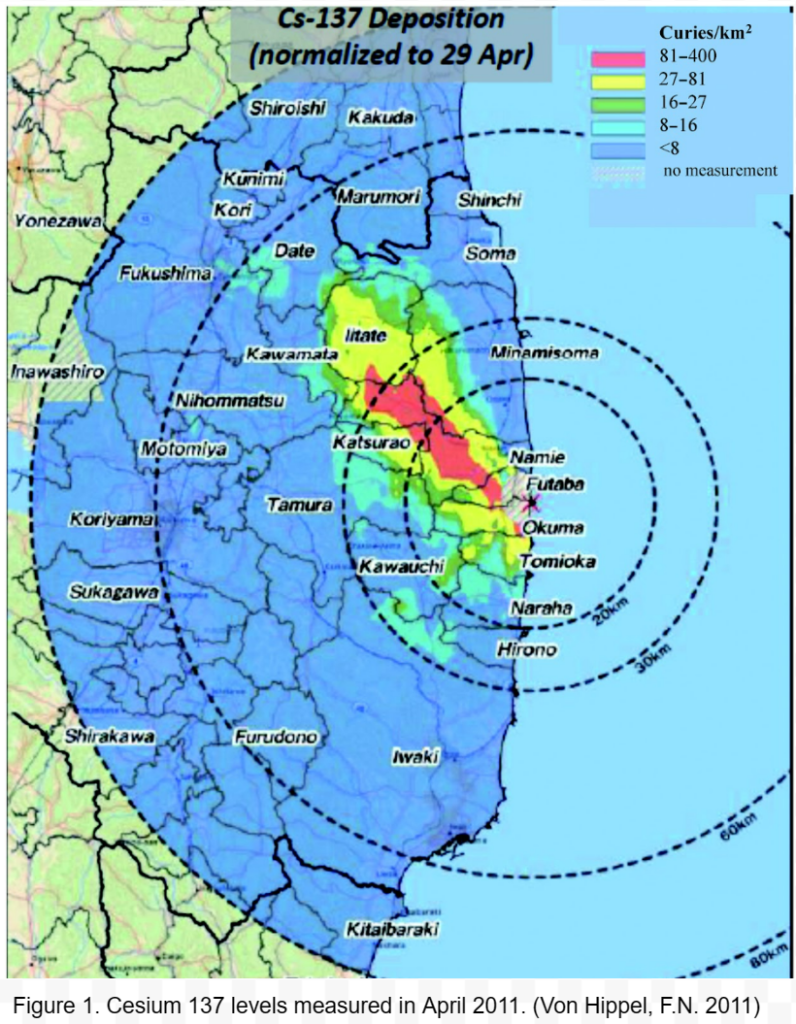
Ukrainian scientist Dmytro Grodzinsky characterized these particles as “everlasting wanderers” that defy absorption, carried by the wind from place to place. (Polleri, 2015) It was approximately a month after evacuations, in April 2011, that the Japanese and American governments measured cesium-137 contamination levels around Fukushima. That data set suggested airborne travel in a northwest trajectory (Figure 1). But in 2014, when the Japanese and American governments took new measurements, they released a very different map. Radioactive cesium was shown to be flowing southwest, as opposed to northwest, towards Tokyo. (Figure 2)
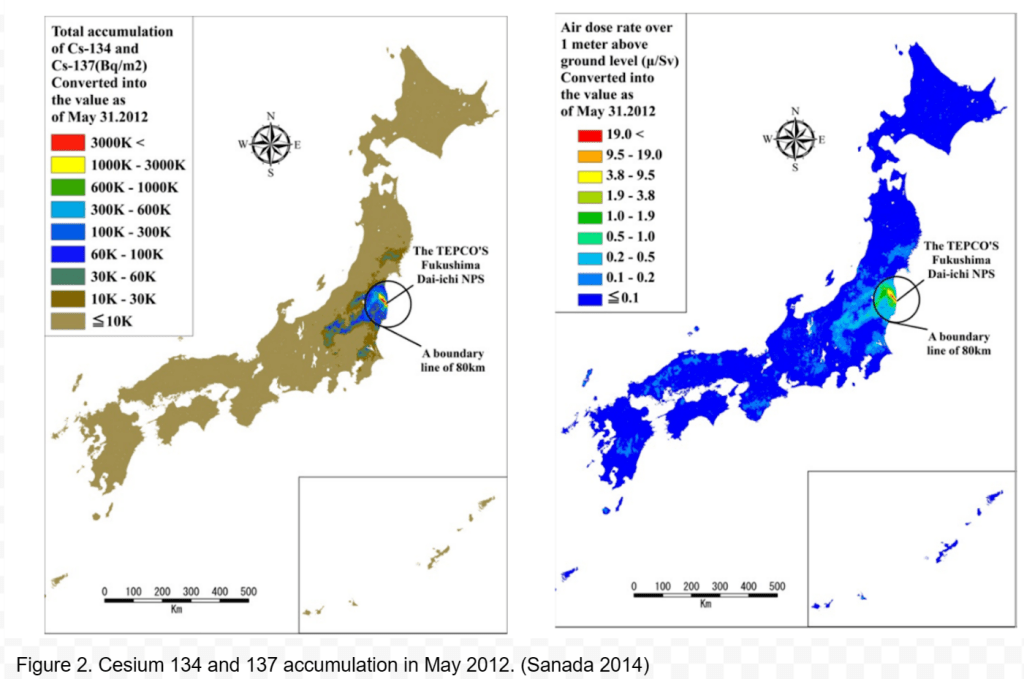
As physical phenomena, radioactive materiality flows through the landscape in dynamic trajectories from its origin in Fukushima. For a traumatized public attempting to negotiate their proximity to radiation – concerned about where “it” is, where it’s going next, and what stuff (like moss, dirt, houses, people, roads, fish) has been exposed to it – these maps do very little. Moreover, eighteen months had lapsed between the aerial data capture and the release of the map to the public. Particle-monitoring maps, however frequent in their release, fail to capture and communicate both actual and potential flows. Ultimately 160,000 people were affected by voluntary or mandatory evacuation zones, and they and the public are being told to make their own decisions regarding risks of radiation exposure. (Broinowski, 2013) With public communications on risk lacking these complexities, individual citizens have lost their ability to make effective or informed decisions about their proximity to radiation.
Open-set of all things contaminated
A month after the disaster, official radiation exposure safety limits were raised, resulting in an erosion in public trust. (Broinowski 2013) Radioactive materials, their dangers, and measurement instruments became common knowledge in Japan. (Inose 2014) What is and isn’t contaminated?
As seen above, conventional particle monitoring can flatten radioactivity’s agency. (Polleri 2015) When defining a limit, where beyond that limit becomes unsafe, “disputes inevitably emerge: how close to the ‘edge’ may one be”? (Sha 2012) A gap festers between residents and the scientific method, which presupposes that its metrics to determine “quite literally what counts [as contaminated] and what does not” will be sufficient for a traumatized public. (Fortun 2004 as cited in Polleri 2015)
The ongoing dispersal of radioactive contaminants into the environment – compounded by activities such as waste incineration, relaxations in official government food testing, the circulation of seafood from Fukushima’s coast, and reuse of contaminated areas by fast-food chains for cheap food production – has contributed to a public perception of continuous exposure to bioaccumulating radioactive material. (Broinowski 2013) Can, then, someone on or near the border of an evacuation zone be considered truly safe? “That is, wholly non-contaminated?” (Polleri 2015) What are the limits of exposure, and how are they determined? Perhaps perceived nuclearity is better understood as a topological set, which “welcomes members, and does not have a sharp litmus test for membership.” (Sha 2012)
One stress response to trauma is hypervigilance, a state of being on constant guard for any signs of danger or risk. In post-Fukushima Japan, nowhere has this been more pronounced than in food safety. A week after the disaster, the Japanese government admitted the threat of radiation leaks to food safety but stated that the extent of the threat was uncertain. Later that year, official government data showed that just a fraction of vegetables, seafood, and rice exceeded safety standards for radiation at 3%, 2.2%, and 20% respectively. Two years later in 2013, only 4% of seafood exceeded standards – while no rice or vegetables did. (Kimura 2016) These numbers reveal government scientism.
In response, citizen scientists across Japan undertook a parallel monitoring of the Fukushima region and its agricultural products. Skeptical of official guidance, women formed groups and constructed community labs to measure and record the radioactive contamination levels of food. (Kimura 2016) Citing their resolve to protect themselves and their children, food was one of few ways in which an open set of all things (possibly)contaminated was made tangible. Food is fundamentally cultural; it reflects values, traditions, respected ingredients and preparation methods, and is tied to rituals both sacred and mundane. Food decisions, especially as made by a traumatized public, struggle to be firmly data-driven.
These spontaneous, citizen-run radiation measurement centers designed a robust network that offered the consistent assurance of safety people desperately needed. Trauma, as an aspect of a person’s lived experience and their own sensemaking, thus extends to the expectations people have of data and technological instruments. As explored in multiple case studies by Chen et al (2022), design of technology too often dismisses these reactions and experiences.
Density as perceived or measured
Nuclearity has been made visible by governments and researchers, insofar as they have organized (and screened) information collection related to evacuation zones, radiation monitoring, cancer screenings, nuclear waste management, and decontamination. (Kumaki 2022 and Broinowski 2013). But these data-driven approaches have confused the number-measure for the numbered thing: “most phenomena in the world come to us without numerical measure or metric.” (Sha 2012)
The maps we saw earlier, aimed at demarcating hazardous and safe zones through a limit on safe and unsafe density measures, inadvertently created a stark division between Fukushima and other prefectures. Sendai, one of the largest cities in Japan in nearby Miyagi prefecture, despite its closer proximity to the disaster site has faced comparatively little discrimination against its products, people, and produce. These maps have indirectly perpetuated the perception of Fukushima residents and evacuees as potentially unhealthy or impure: “These perimeters send a clear binary message: some people are contaminated, while some are not.” (Polleri 2015)
Trauma is different from stress in how deeply the event is related to on the level of belief systems. (Deitkus 2022) When fundamental belief systems are strained or broken, like the public’s trust in science, traumatic stress responses like distrust take hold. Most recently, China has placed a ban on all Japanese seafood imports in response to Japan’s release of treated radioactive waste water into the Pacific Ocean. The density of radioactive particles in this treated wastewater is well within safety limits and has been deemed safe by the World Health Organization. Even so, the density that is felt, assumed, and feared holds more strength than the density that is measured. The Chinese public is in support of the ban, with comments on Weibo including calls to ban all Japanese products, or that Japan is irresponsible. (Toh 2023)
Such controversy is inevitable. We’ve known since the 1950s from nuclear weapons testing by the United States in the Marshall Islands that man-made radioactive material doesn’t dissipate or fade with time. It collects and moves in pockets and streams through the water. (Broinowski 2013) In a topological sense, such accumulation begins to signify the interconnectedness of different species and phenomena within an ecosystem. Measures attempting to define safe density, like in wastewater release, don’t quell any psychological fears that persist among the public about exposure and potential effects. Inose (2014) argues that this problem reflects Latour’s “hybrid” lifeworld where the natural and the artificial (in this case, man-made radioactive materiality) are perpetually intertwined. For Fukushima, there have been “increasingly divergent responses” to integrated nuclearity. (Kumaki 2022) Some chose to evacuate to far distant areas, others chose to source their food from other regions of Japan. In sharp contrast, others – especially the elderly – have returned to former evacuation zones.
Bioaccumulation of radioactive material in the environment continues to be monitored, though the Japanese government estimated the release of radioactive material into the atmosphere to be about one-tenth that of Chernobyl. (Von Hippel 2011) In an effort to make public health assurances, there have also been comparisons between the disaster’s radioactive leaks with natural background radiation or activities like air travel, X-rays, and bananas. (Broinowski 2013) But consensus has been that the human body’s adaptation to these natural sources of radiation is markedly different from anthropogenic radioactive materials. Once introduced into the food chain, radioactive man-made materials create a persistent and unnatural burden of radioactive ionization that takes a considerable time to stabilize in the environment, often spanning around 100,000 years. Radiation and topological nuclearity are, thus, quite different media.
Temporal dis/connectedness
Any shared conventions that once bound people together in a collective sense of reality disintegrated in the aftermath of Fukushima. (Inose 2014) Individuals were left to amalgamate fragments of knowledge, through which they navigated an uncertain future. Individual reactions to nuclearity, namely migration, has fundamentally changed the demographics of Fukushima and its communities.
The exodus from Fukushima has been a mix of voluntary and mandated. Decontamination has been linked with a policy of relocation, displacing people from their homes; a systematic upheaval of communities that has underscored the profound interconnectedness of people’s lives with their lived ecologies. (Zhang 2014) Inose describes these policies to have “privileged certain socio-ecological arrangements, particularly those that assume the separability of people and communities from their land in the face of radioactive contamination.” (2014) Japanese fishermen continue to feel anxiety about their industry. (Toh 2023)
These policies have of course been an attempt to manage risks to human health. After 1945, chronic effects such as fatigue, cardiac abnormalities, various cancers, leukemias, alopecia, skin lesions, and rashes were observed in survivors of atomic bombs in Hiroshima and Nagasaki as attributable to low-dose internal radiation exposures. The Daiichi plant’s meltdown was a very different kind of disaster, so it wasn’t clear in 2011 what the long-term consequences of the accident would be.To date, there have been no documented cases of adverse health effects on Fukushima residents or nuclear power plant workers. However, in other species like horses, mice, and earthworms, there have been observations of excessively high rates of liver failure, genetic mutations, and infant mortality. (Broinowski 2013)
The current lack of documented human health effects may or may not be evidence of effective evacuations and relocation, or even effective decontamination. It could also be that simply not enough time has passed. Though simple removal of radioactive debris is an efficient method of decontamination, there are large swathes of radioactive mountainous forest that are inaccessible. There, radioactive “litter” accumulates: “continuously decomposed and contaminated leaves will continue to fall on the soil surface for several years.” (Hashimoto 2012) As forms of matter, cesium-137 and strontium-90 endure in the environment over lengths of time that are difficult for us to comprehend. These temporal aspects of nuclearity emphasize radiation’s enduring impact over time. Temporal continuity, as the persistence of radioactive particles, has effects which can span years and generations. Younger evacuees are the least likely to return to former evacuation zones while, in contrast, the elderly are the most likely demographic to remain. (Zhang 2014) Fear of long-latency effects could also be a motivator for young people to voluntarily migrate out of the region.
Topological dynamics for trauma-informed information design
Differences in negotiating residence in areas deemed un/safe and de/contaminated emphasize a complex calculus undertaken by each individual. Zhang’s research found three core sources of psychological distress leading to migration: 1) unknown health risks in low radiation zones, 2) economic uncertainties in the affected areas, and 3) distrust in government information. (2014) Insufficient information disclosure on airborne radiation, for instance, led local groups to self-organize, collect and share test data. Contaminated debris storage and disposal have triggered safety questions. (Kimura 2016)
What makes someone, or something, contaminated? Deeply held binary beliefs about what is clean and what is dirty resist metrics. Nuclearity as a topological media emphasizes the idea that we are dealing with permeable boundaries that are not physical or geographical, but conceptualizations that acknowledge our interconnectedness with nature.
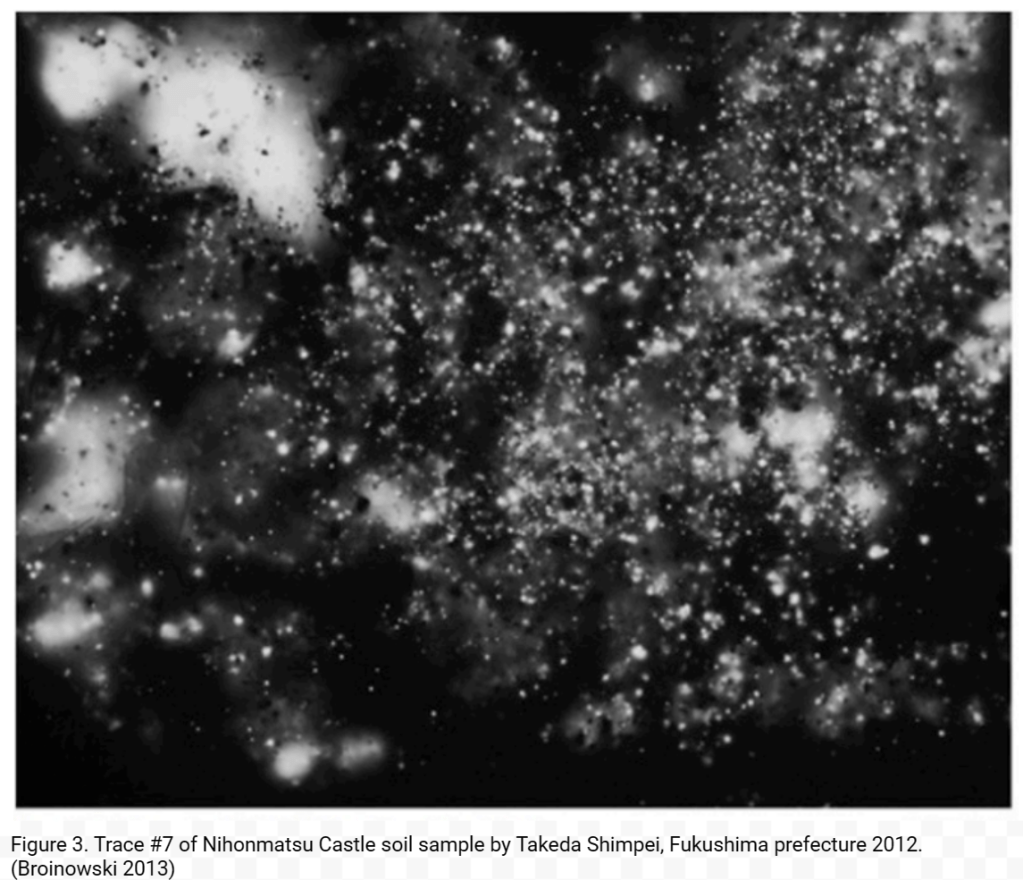
In a project entitled “Trace,” artist Takada Shimpei collected soil samples from 12 culturally significant locations across northern Japan. He placed them on photo-sensitive materials in a light-sealed box. Under nuclear decay, the ionizing products imprinted on the film (figure 3) – creating a visual record of burning present in the soil. When metabolized, whether through food, water, or air, these particles continue to burn – even within the body. “Trace” seems to challenge the fundamental meaning of a radiation dose limit. It enables a visualization of contamination and contaminated cultural sites in a way that metric-driven monitoring does not. It speaks to the public’s perceptions and anxieties of what is or isn’t contaminated, and where danger is; it also, symbolically, makes it clear that nuclearity is within us.
Broinowski (2013) argued that as the government employs tactics of persuasion and misinformation in the public domain, promoting narratives of optimism and national unity, the assertion of affected citizens seeking compensation for evacuation and healthcare faces increasing challenges. Despite efforts to dispel “baseless rumors” and encourage evacuees to return home, the government’s screening of information has impaired the ability of citizens, both from mandatory and voluntary evacuation zones, to make informed decisions regarding radiation risks. The lack of essential details and treatment information regarding radiation levels in the environment, food, and water has left citizens vulnerable to potential harm from various radionuclides, undermining their capacity to safeguard against radiation exposure.
More than a decade on, about one in ten people have returned to former evacuation zones. For farmers, “being able to plant seeds and share harvests from their land—and to do so as a community—were activities central to the creation of a meaningful life.” (Kumaki 2022) But Fukushima’s soil faces complicated socio-ecological conditions. Radioactive products continue to circulate in the biosphere over deep geological time. “Through repetition of the message that ‘all is safe’, radiation monitoring could become like weather readings, announced and accepted as a fact of life.” (Broinowski 2013)
Nuclearity in the lifeworld poses questions: “Radiation is invisible, so how do you know when you are in danger? How long will this danger persist? How can you reduce the hazard to yourself and your family? What level of exposure is safe? How do you get access to vital information in time to prevent or minimize exposure? What are the potential risks of acute and chronic exposures? What are the related consequential damages of exposure? Whose information do you trust? How do you rebuild?” (Johnston 2011) We begin to glimpse some of the fundamental gaps in official data collection and disclosure. Individuals are faced with decision-making on their health, well-being, and economic future, while juggling shifting trust in government data and their personal-historical ties to their land. If information systems are to be human-centered in their design, then they must be trauma-informed. Seeing nuclearity as a symbolic topological substance opens space for these considerations by prompting empathy for experiential distributional/density effects, proximity negotiations, and interconnectedness, while the prevailing scientism in guidance hinders effective decisions and recovery.
References
- Broinowski, A. (2013). Fukushima: life and the transnationality of radioactive contamination. The Asia-Pacific Journal, 11(41).
- Chen, J. X., McDonald, A., Zou, Y., Tseng, E., Roundy, K. A., Tamersoy, A., … & Dell, N. (2022, April). Trauma-informed computing: Towards safer technology experiences for all. In Proceedings of the 2022 CHI conference on human factors in computing systems (pp. 1-20).
- Dietkus, R. (2022). The Call for Trauma‐Informed Design Research and Practice. Design Management Review, 33(2), 26-31.
- Hashimoto, S., Ugawa, S., Nanko, K., & Shichi, K. (2012). The total amounts of radioactively contaminated materials in forests in Fukushima, Japan. Scientific reports, 2(1), 416.
- Inose, K. (2014). ” Living with Uncertainty”: Public Anthropology and Radioactive Contamination (< Special Issues> Practicing a Public Anthropology of the East Japan Disaster). Japanese Review of Cultural Anthropology, 15, 141-150.
- Johnston, B. R. (2011). Anthropological Voice on the Fukushima Nuclear Disaster… SfAA President’s Column, 6.
- Kimura, A. H. (2016). Radiation brain moms and citizen scientists: The gender politics of food contamination after Fukushima.
- Kumaki, H. (2022). SUSPENDING NUCLEARITY: Ecologics of Planting Seeds after the Nuclear Fallout in Fukushima, Japan. Cultural Anthropology, 37(4), 707-737.
- Polleri, M. (2015). “Matters” of Importance: Contaminated Materiality in the Aftermath of the Fukushima Disaster. Nexus: The Canadian Student Journal of Anthropology, 23(1), 13-25.
- Sanada, Y., Sugita, T., Nishizawa, Y., Kondo, A., & Torii, T. (2014). The aerial radiation monitoring in Japan after the Fukushima Daiichi nuclear power plant accident. Prog. Nucl. Sci. Technol, 4(7), 76-80.
- Sha, X. W. (2012). Topology and Morphogenesis. Theory, Culture & Society, 29(4-5), 220-246. https://doi.org/10.1177/0263276412443570
- Toh, K. M. (2023, August 28). China says its ban on Japanese seafood is about safety. Is it really? | CNN Business. CNN. https://edition.cnn.com/2023/08/27/business/japan-fukushima-water-china-import-ban-intl-hnk/index.html
- Von Hippel, F. N. (2011). The radiological and psychological consequences of the Fukushima Daiichi accident. Bulletin of the Atomic Scientists, 67(5), 27-36.
- Zhang, H., Yan, W., Oba, A., & Zhang, W. (2014). Radiation-driven migration: the case of Minamisoma City, Fukushima, Japan, after the Fukushima nuclear accident. International journal of environmental research and public health, 11(9), 9286-9305.
 BreeFabig.me
Leave a comment