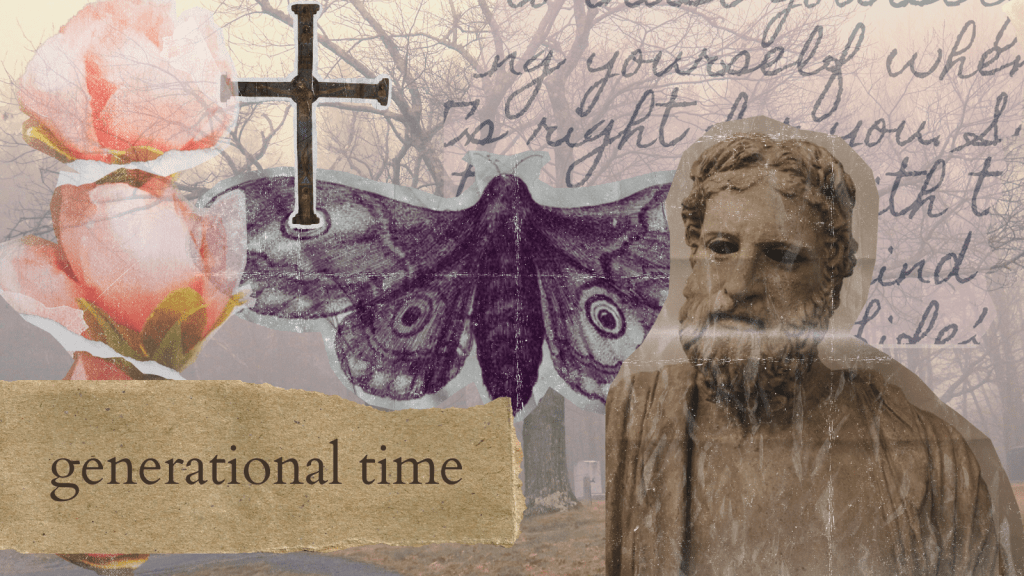
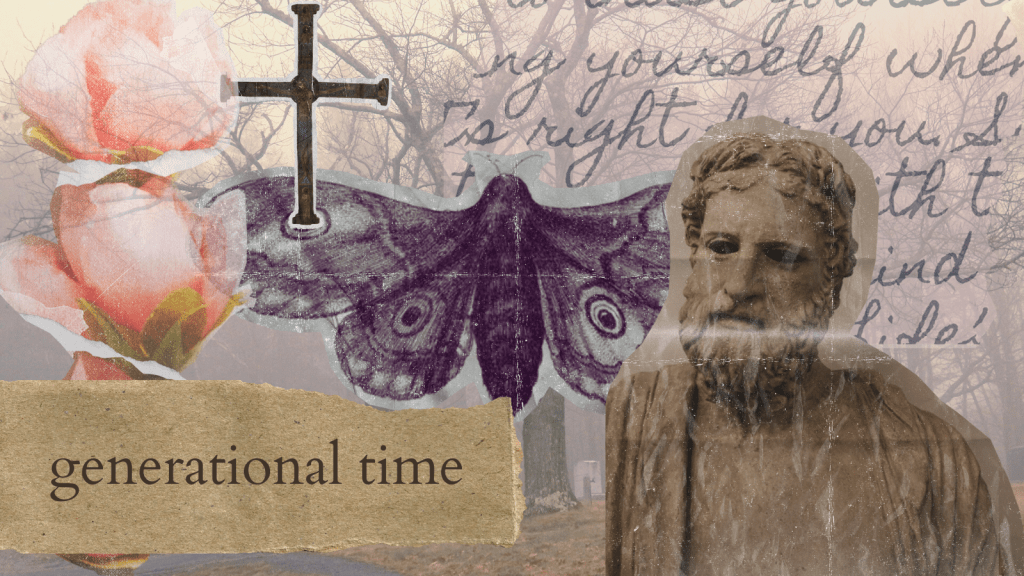
For a place of death, the cemetery felt pregnant with meaning. Many graves had sunken in. A variety of tall statues of angels were lopsided here and there, facing now in one direction or another, holding on to mounds of earth. The grass, overgrown and yellow from the August heat, looked like wheat.
A few runners passed through, checking their Fitbits to avoid eye contact. Further into the grounds behind a stone enclosure I saw a middle aged woman wearing a sports bra sunbathing in a lawn chair. In her right hand was a beer absentmindedly pointed toward the maze of graves around her, held as if it were an offering.
We must have spent less than ten minutes walking through the cemetery. I stopped to read a few gravestones for dates and names. My daughter chased a squirrel. My husband commented on a single Jewish grave. Then we were back on the busy street, heading for the station.
Our walk through the cemetery was entirely serendipitous. We had got off the tube at the wrong station and figured a sauntering walk to Hammersmith through what looked like a park would be a lovely reprieve from the hot weather. Instead, I skimmed the names of the dead, hundreds of years apart in birth and death. There was something about the line “Thomas, also his wife Annie Elizabeth,” that I particularly liked.
The dead felt present in a way they didn’t in the United States. There, I would have to physically drive to a cemetery with the explicit intention for a walk among bones – a strange thing to do.
After three weeks in London I’m experiencing an anchor to time that I never did in Seattle. For me, natural landscapes offer this sensation far more than urban ones. But London has a different ring to it. The tall, centuries-old cathedrals and grimy old stone roads I associate with Europe. Next to these scenes are Amazon Fresh stores, farmers markets, glittering new office buildings, and families at picnics having conversations in languages from other hemispheres.
Living a modern life in an ancient city offers more than an anchor to time. The abundance of vegan eateries, Extinction Rebellion graffiti, and overall emphasis on recycling is quite a culture shock coming from America. A sense of knowing that I’m part of history-in-making; as if the future generations for whom we must restore the environment are present under the shadows of the oak trees in the borough parks.
The vibrancy of life occurring not just around the cemetery but within it echoed this sentiment. There was such life to witness: the runners, with their hearts racing and bodies covered in beads of sweat; squirrels burying acorns beneath sod for winter; an elderly man placing glorious pink dahlias at the grave of a woman who died in 1931.
Somehow, the problems we face as a species feel far more real than they did just a month ago. Perhaps the heatwave and drought conditions in Europe are making climate change particularly potent this summer.
Either way, I recovered a quote from environmental activist Joanna Macy that I had saved some time ago, which captures, I think, this ache:
Two hundred years is the approximate lifespan of seven generations. The Onondaga, one of the Six Nations of Haudenosaunee people… always consider the concerns of the seven previous and the seven following generations when they have to make far-reaching decisions. Thinking in this way, if there is human life in two hundred years, the people of that time will likely tell stories about the corporations that seemed to rule the planet in our era and the vast amounts of toxic chemicals that were dumped into the earth, air, and water. But they will also talk about us, their ancestors who refused to go along. They will speak of those who, despite initial feelings of being alone and out-numbered, followed their inner wisdom and their respect for life and said, “Something is wrong.”
Joanna Macy, 2010
 BreeFabig.me
Leave a comment